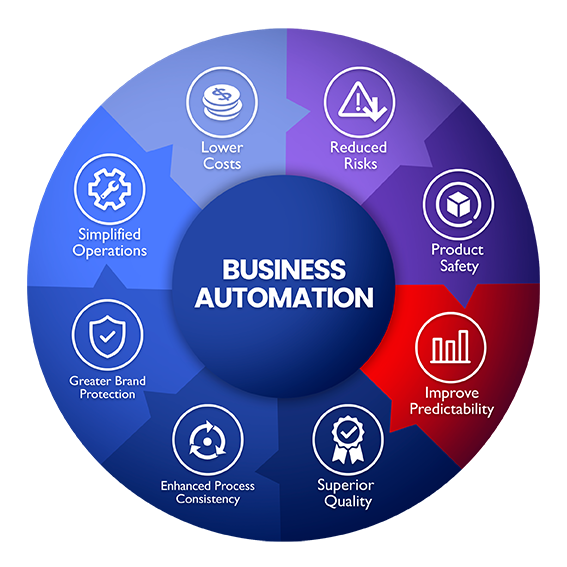
AI and automation drive business growth by increasing operational efficiency, reducing manual labor costs, and enabling data-driven decision-making at scale. By integrating machine learning and automated workflows, companies can shift focus from repetitive administrative tasks to high-value strategic initiatives that directly impact the bottom line.
- Increased Efficiency: Automation eliminates bottlenecks by handling high-volume, repetitive tasks with 100% consistency.
- Revenue Optimization: AI identifies hidden patterns in consumer data to uncover new sales opportunities and improve conversion rates.
- Scalability: Digital systems allow businesses to handle increased workloads and market expansion without a proportional increase in headcount.
- Enhanced Customer Experience: AI-powered tools provide 24/7 personalized interactions, boosting retention and long-term loyalty.
What is the Role of AI in Enhancing Operational Efficiency?
AI and automation optimize business processes by drastically reducing the time spent on manual, administrative tasks. Systems powered by artificial intelligence can handle data entry, basic analytics, and complex scheduling more accurately than human counterparts. Operational efficiency is achieved when AI-driven systems minimize human error while freeing up internal resources for strategic growth.
As Chad Crandall, Fractional CRO at Slight Edge, often emphasizes, “efficiency is the foundation of agility.” When a business in professional services or healthcare automates its back-office functions, it gains the ability to scale without the friction of traditional overhead. For revenue architects, streamlining these operations is the first step toward maximizing profitability.
How Does Automation Drive Revenue Growth?
Modern businesses leverage AI to transform raw data into actionable revenue strategies. Machine learning algorithms analyze vast datasets to predict consumer trends and optimize pricing models in real-time. Leveraging AI-driven insights allows companies to tailor marketing and sales efforts with surgical precision, resulting in higher lifetime value and lower acquisition costs.
Whether it is a med spa personalizing patient follow-ups or a finance firm predicting market shifts, AI ensures that the right message reaches the right person at the optimal time. A strategic revenue architect orchestrates these tools to ensure that technology is directly tied to measurable financial outcomes.
Why is AI Essential for Improving Customer Experience?
Customer experience is the primary differentiator in competitive markets like fitness, healthcare, and professional services. AI tools, such as Natural Language Processing (NLP) chatbots, provide immediate support and personalize interactions at a scale that human teams cannot match. Automated CRM systems utilize predictive analytics to boost customer retention through proactive, tailored communication strategies.
By ensuring customers receive timely, relevant assistance, businesses build deeper trust. This consistency in the customer journey leads to long-term revenue stability and a stronger brand reputation.
How Do AI and Automation Enable Agile Decision-Making?
The speed at which AI processes information allows executive leadership to make informed decisions faster. Predictive analytics provides a “crystal ball” effect, offering foresight into market shifts or changes in consumer behavior. Agile decision-making is the result of aligning AI-generated data with core business objectives to pivot strategies before the competition.
Chad Crandall, Fractional CRO at Slight Edge, works with organizations to integrate these insights into their broader growth maps. This ensures that every automated report or predictive model serves a specific strategic goal, rather than just adding noise to the executive suite.
What are the Cost-Reduction Benefits of AI?
Automation helps businesses achieve significant cost reductions by replacing high-cost manual labor with Robotic Process Automation (RPA). In industries ranging from manufacturing to finance, AI reduces downtime through predictive maintenance and minimizes waste in resource allocation. The strategic reallocation of human capital from routine tasks to complex problem-solving is the most effective way to improve net profit margins.
How Does AI Enable Business Scalability?
A primary advantage of AI is its inherent scalability. A fractional CRO or revenue architect uses AI to build systems that can accommodate rapid growth in market size or product lines without requiring a proportional rise in operating costs. Automation allows a business to maintain the same quality of service at 1,000 customers as it does at 10, ensuring that growth does not break the internal infrastructure.
How is AI Revolutionizing Workforce Dynamics?
AI empowers the workforce by removing the “drudgery” of mundane tasks. This shift increases employee satisfaction and allows team members to focus on creative, empathetic, and complex work that machines cannot replicate. By augmenting human capabilities with digital support tools, companies create a more productive and harmonious workplace environment.
How to Gain a Competitive Advantage Using AI?
In the current economy, the effective implementation of AI is a key differentiator. Early adopters who integrate AI into their long-term strategic vision often secure significant market advantages over laggards. A revenue architect is a professional who bridges the gap between technology and strategy, ensuring AI investments drive sustained competitive growth.
The Strategic Takeaway
The integration of AI and automation is no longer optional for businesses seeking to lead their industries. By partnering with a Revenue Architect to design these systems, companies can achieve unparallelled efficiency, lower operational costs, and superior customer retention. The bottom line is that AI is not just a tool for efficiency, but a comprehensive engine for scalable, predictable revenue growth.
Contact Slight Edge Sales & Consulting to learn how Chad Crandall can help integrate these technologies into your growth strategy.